User Guide · Part 1: Understanding Your Taper
Why Stopping Benzodiazepines Can Be Hard
GABA is your body's own calming chemical. It works by fitting into receptors on your nerve cells.
Benzodiazepines attach to a different spot on these receptors and make GABA's calming effect stronger. Over time, especially with a large dose or long-term use of a benzodiazepine, your nerve cells adjust by reducing the number of working GABA receptors.
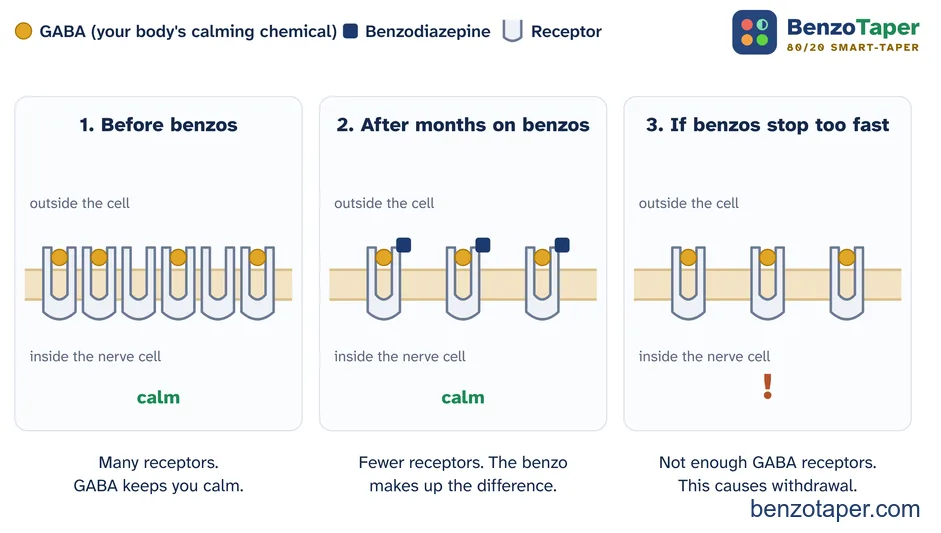
If you stop taking your benzodiazepine too quickly, there are fewer working GABA receptors than before, so GABA's calming effect is weaker at first. A slow reduction gives your nerve cells time to build up more GABA receptors again.
A proper taper gives your nerve cells time to increase the number of GABA receptors.
What "Half-Life" Means
A medicine's half-life is how long it takes for half of it to leave your body.
For example, if a medicine's half-life is 12 hours:
| Time after one dose | How much is left |
|---|---|
| 12 hours | Half (50%) |
| 24 hours | Half of the above half, or a quarter (25%) |
| 36 hours | Half of the above, or an eighth (12.5%) |
| 48 hours | Half of the above, or about 6% |
After each half-life period, half of what is left goes away. So, the amount drops fast at first, then more slowly.
Lorazepam's half-life is about 12 hours.
Diazepam's is about 48 hours, and it breaks down into another calming substance that lasts even longer.
That difference matters a lot during a taper. The next pages show why with a comparison between the short half-life benzodiazepine Lorazepam and the long half-life benzodiazepine Diazepam, which is the one the 80/20 Smart-Taper uses.
Note: Zolpidem (Ambien) and Zopiclone (Imovane) are technically non-benzodiazepine sedative-hypnotics.
All chapters of the User Guide
Use it for your own taper
BenzoTaper 80/20 Smart-Taper is the taper schedule that updates itself. Pause, change your pace or restart on any day, and every date, dose, tablet and prescription request updates in one click.